Panama Canal
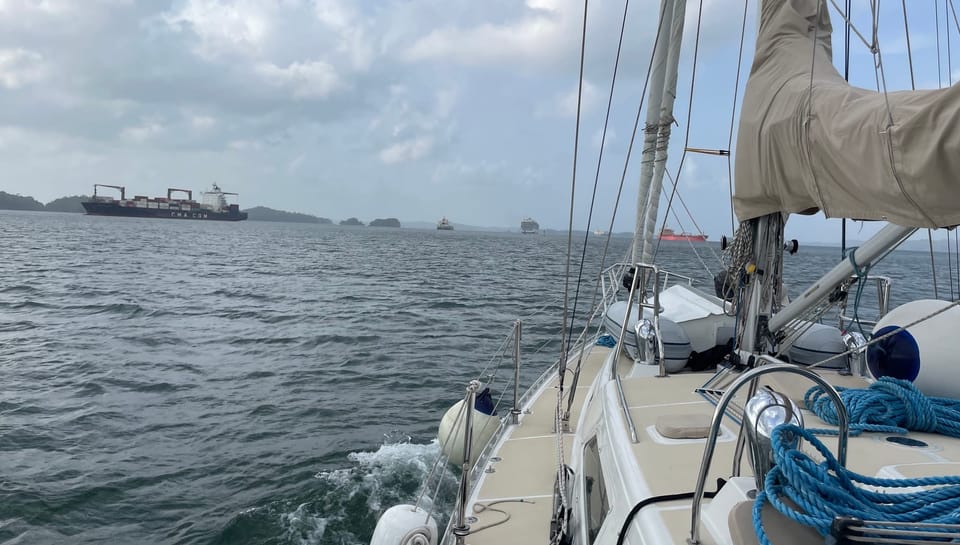
Our Panama Canal transit on April 8, 2024:
I awoke at 0200, full of restless anxiety and ready to go, even though the alarm was set for 0300. The required lines and fenders and the professional line handler would arrive at 0400. My first task, as always is to make the coffee. I have done this in Pinecone probably a thousand times but on this occasion, I leaned too far over the counter to grab at the coffee beans. In so doing my chest pushed over my beloved and always durable glass Chemex causing it to topple over and shatter. I swore a line of curses, stirring Wendy awake. This did not feel like a good omen.
Switching to another method to make the coffee, I continued my process. Soon after I started up the engine and turned on the navigation lights and steaming light. The bow red and green nav light was a battery backup that would stand in for our permanent replacement that we would install later. I switched off shore power and disconnected and coiled our cord. Same for water. I paced the dock and reconfirmed our exit strategy given the wind direction and strength. Everything looked favorable for a quiet and contained departure using only one person to cast us off - our canal agent Roy Bravo.
Roy had arrived at 4am, exactly as scheduled. He brought 4 chunky and very long blue poly lines, one for each “corner” of Pinecone, 2 aft, 2 forward, starboard and port. He brought 6 - A4 Polyform white spherical fenders, the kind meant for much larger ships. The fenders were clean and he laughed and said: “I will know what kind of transit you had by the color of them when I see you on the other side.” He also brought Gabi, a young smiling muscular man who would help us greatly in our line handling efforts. Wendy and I were joined by our terrific friends and sailors Tom and Nancy. Each boat needs 4 line handlers and one dedicated helmsperson. Roy cast off Pinecone at 0415 and waved us goodbye and we slowly pulled out of our slip and into the predawn darkness to make our way to “the anchorage” a short distance outside the marina.
Arriving at 0430 in the anchorage field, we started to slowly circle within a triangle of 3 flashing canal buoys to await the arrival of our advisor. There was a slight chop and winds about 15 knots. The main channel of the canal was already humming with big ship traffic. Actually it never stops humming 24/7. The launch carrying the advisor was spotted or rather spotted us with their powerful searchlight. Of course, they are headed to us at what seemed like excessive speed. “The launcha” is a steel 40’ pilot house workboat with high freeboard and a flat deck forward with a stout handrail down the middle for making one’s way onto another vessel like ours. The line handler directed me to go to slow forward, the launch pulled up, threw their engines into hard reverse and stopped a foot away and and 3’ above our decks. Before I could react, 2 advisors were on board making their way along the side decks and into the cockpit. Advisors are required by the Canal authority to be aboard every boat. They direct and guide the helmsperson as needed to make the transit successful.
McClain, a stoic, no nonsense, advisor immediately informed me what to do. The second advisor trainee, affable and open, Felix was on board to get additional experience before he is allowed to advise directly. I liked McClain immediately. A man of few words, he instilled confidence with his clarity. He pointed to a tanker ship steaming in the main channel beside us and said we would be getting in line behind them into the first set of locks. He also pointed to a sailboat ahead of us and said we would raft up with them in position behind the large tanker once we got near the lock. We pulled into the traffic lane, staying along the starboard side of the channel allowing maximum room for the tanker, alternating slow forward and drifting so that we would not arrive too soon. The sky lightened as we made our way to the other sailboat, a much smaller 35’ sloop, tiller steered with a 25hp engine. We prepared our port rail with fenders to secure the vessel and tied up tightly. The rules are that larger vessels and/or vessels with the bigger engine becomes the raft driver. I was now responsible for piloting 2 vessels that moved as one. Pinecone’s new raft wasn’t any longer than she alone but she was another 10’ wider and handled somewhat differently. It should be noted that you spend all your time around boats trying to stay safely away and now, our rails are less than 1 foot apart separated by fenders and moving as one. It was surprisingly easy to manage the smaller boat, just a bit more throttle and rudder angle to compensate for no longer having the rudder along the midline. The young French cruising couple, were perfectly pleasant and as wide eyed as ourselves as we slowly motored them and us into position into the first lock at Gatun.
Once the big ship was secured, the advisor signaled to pull up close behind them keeping our rafted ship in the center of the lock with roughly equal distance from side to side. Then, from high up the lock walls, the land handlers launched their baseball sized steel-weighted-moneky-fists-wrapped-in-protective-cloth messenger lines down to our rafted ship. Two lines per side, one for the bow and the other to the stern. Our expert line handler demonstrated how we take our beefy poly lines and tie the messenger lines to them and then the dock side line handlers haul up our poly lines and hold us tight to a Bollard. Once this operation is complete our rafted ship is securely center tied at 4 points and isn’t moving. It is only then that the gates are closed and then fresh water starts to flood the lock and we and the huge ship ahead of us and way too close for comfort are miraculously floated up approximately 18’ in the rising water. This happens twice more before we reach the level of Gatun Lake.
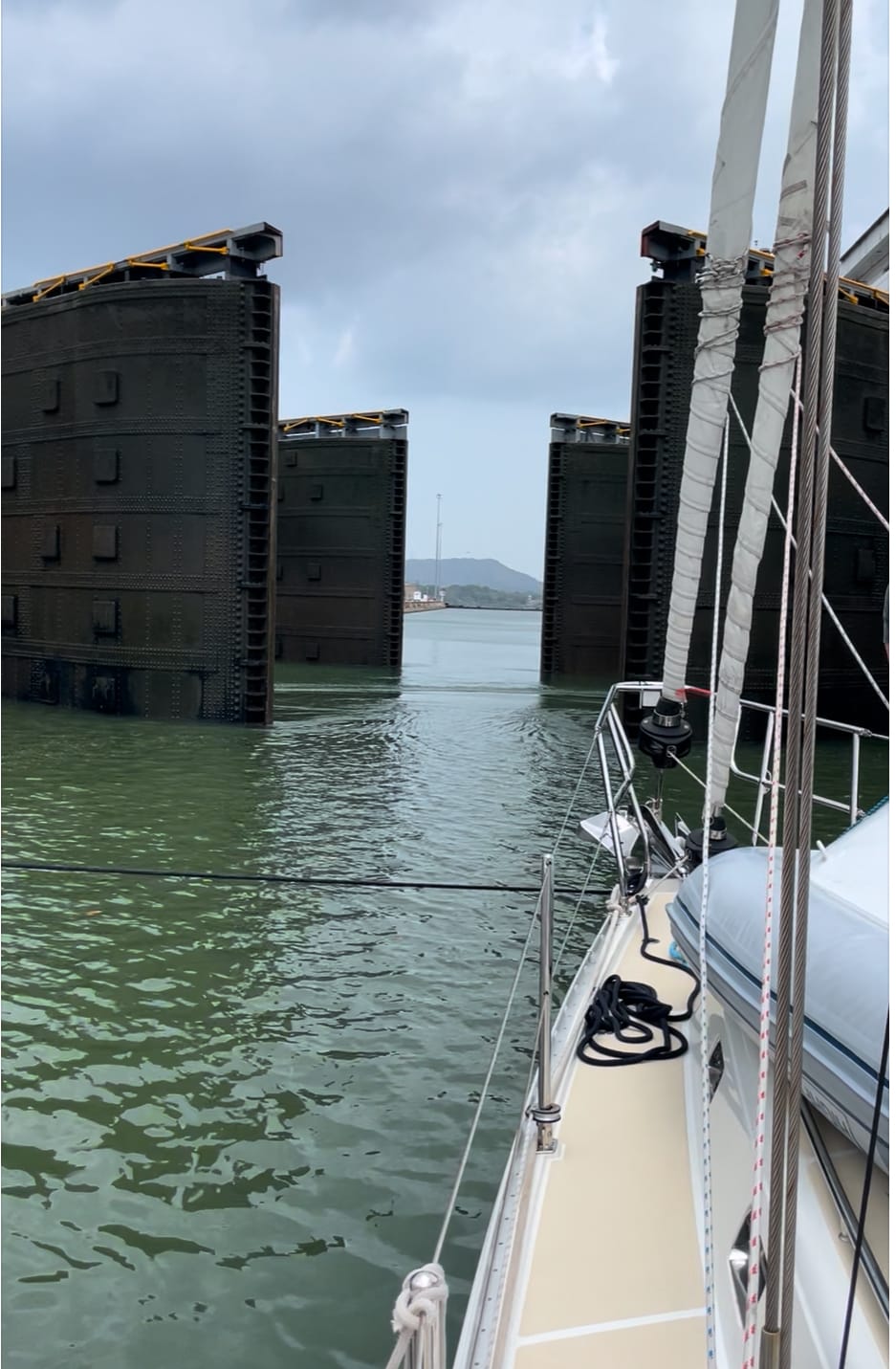
Between each lock, I am instructed to slowly advance our rafted ship forward and keep it as centered as possible as our dock lines are hand walked along the lock walls by the (land) line handlers These first locks at Gatun take us up 85’ in 3 stages. The big ships are towed and controlled by wall side locomotives. In our case, the dock line handlers advance at a walking pace up steep steps to each lock. We leave the Caribbean Sea (Atlantic Ocean) and rise up to meet the continental divide between the oceans. Once we enter, the huge original steel gates slowly shut behind us, the lock slowly fills, we rise and then the forward gates open and we move out. All the while our tiny raft of 2 sailboats is dwarfed by the enormous tanker we share the lock with, the enormous ship behind us in another lock and enormous ships traveling in the opposite direction close by. There is no other time I can imagine that Pinecone will ever be this close to these behemoth ships. The lock system is a marvel of engineering, construction, functionality and logistics, which happen in slow and deliberate motion. I had recently finished McCullough’s “Path Between the Seas”, a very detailed history of the building of the Panama Canal and here now it was alive and very real. Clearly much of the original elements dating to 1913 or so, are still in use and completely operational.
Once we are released into Gatun Lake, an artificially created freshwater reservoir which at the time of its construction was the largest freshwater lake in the world, we untie from the smaller French sloop and make our way across the 21 mile expanse, weaving in and out of islands following the main ship channel. McClain, the advisor, says to me: let’s see how fast Pinecone can go. I push the throttle forward and he raises his eyebrows approvingly as Pinecone starts to reach toward hull speed. I settle in at 8.3 knots, a very nice pace given the flat and calm surface conditions. He is impressed. I ask about the smaller, slower French boat and he says, “forget about them, they can’t keep up”. He does some figuring and makes some calls and determines that we can catch up to the sailboat ahead of us prior to heading into the next series of locks at Pedro Miguel. For the next 2.5 hours we motor through a vast freshwater lake wilderness of many islands. Our seawater bottom growth dies and falls off due to the freshwater environment.
When we approach Pedro Miguel locks in the distance, a series of negotiations ensue via phone calls and radio conversations with McClain and the lock schedulers. He instructs me to keep driving her fast. We catch up to a 47’ French sloop with a crew of four. McClain describes what will happen next. An enormous tug will tie against the lock wall, then the French sloop will tie to her and then we will tie to the French sloop. I do as instructed and with her fenders and our fenders, we make fast along the port rail. The French sailors try and take control of the lashing of dock lines. For the first and only time, McClain raises his voice in clear irritation and emphatically states: “do you want to get through the canal today, then let us do our work!”. Everyone stops, including the advisors and professional line handlers on both vessels and follows his command.
Once we break free from the tug, it is decided that Pinecone will be the mother ship controlling the raft, even though we both are approximately the same size and have similar 80hp engines. This is definitely not the same feel as guiding the smaller boat within Gatun Locks. We are much wider, slower to respond and requires more throttle work. At usual, McClain directs me to via hand signals and one word commands, like engage forward or turn to starboard or slight reverse, etc. His first command is to I turn to starboard in slow forward. I do so but the helm doesn’t respond. He chirps, more starboard now. I have the helm hard over to starboard and tell him so. He looks at the helm of the sister ship, as our collective aft helms are pretty close together and barks at them to: “center your helm and lock it!” Once accomplished, Pinecone can once again guide the raft, albeit with more adjustments to compensate for the size and weight of the French sloop.
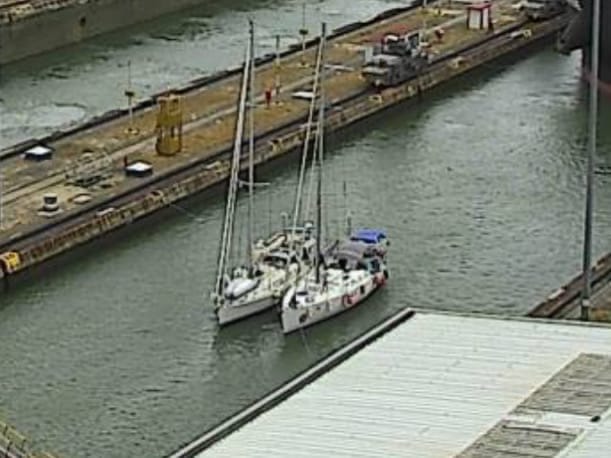
Between the one lock at Pedro Miguel and the final two locks at Miraflores, we are now being lowered a corresponding 85’ down by the release of water draining out of a lock. As a result the dock lines need to be carefully snubbed to control the relative position of the our raft in the center of the lock. From Miraflores, we can see the Pacific. There is also a viewing platform and small museum alongside the lock with a throng of people. We get cheered and celebrated. As we detach from the French boat, we wave goodbye and slowly motor under our final bridge - Bridge of the Americas - as a nice drenching rain envelops us. Up ahead, another launch comes charging into view to pickup the advisors. As before, the launch skipper expertly maneuvered the lurching big steel workboat, picked up the 2 advisors but not before hugs and photos were exchanged and hearty thanks, including a modest cash tip.
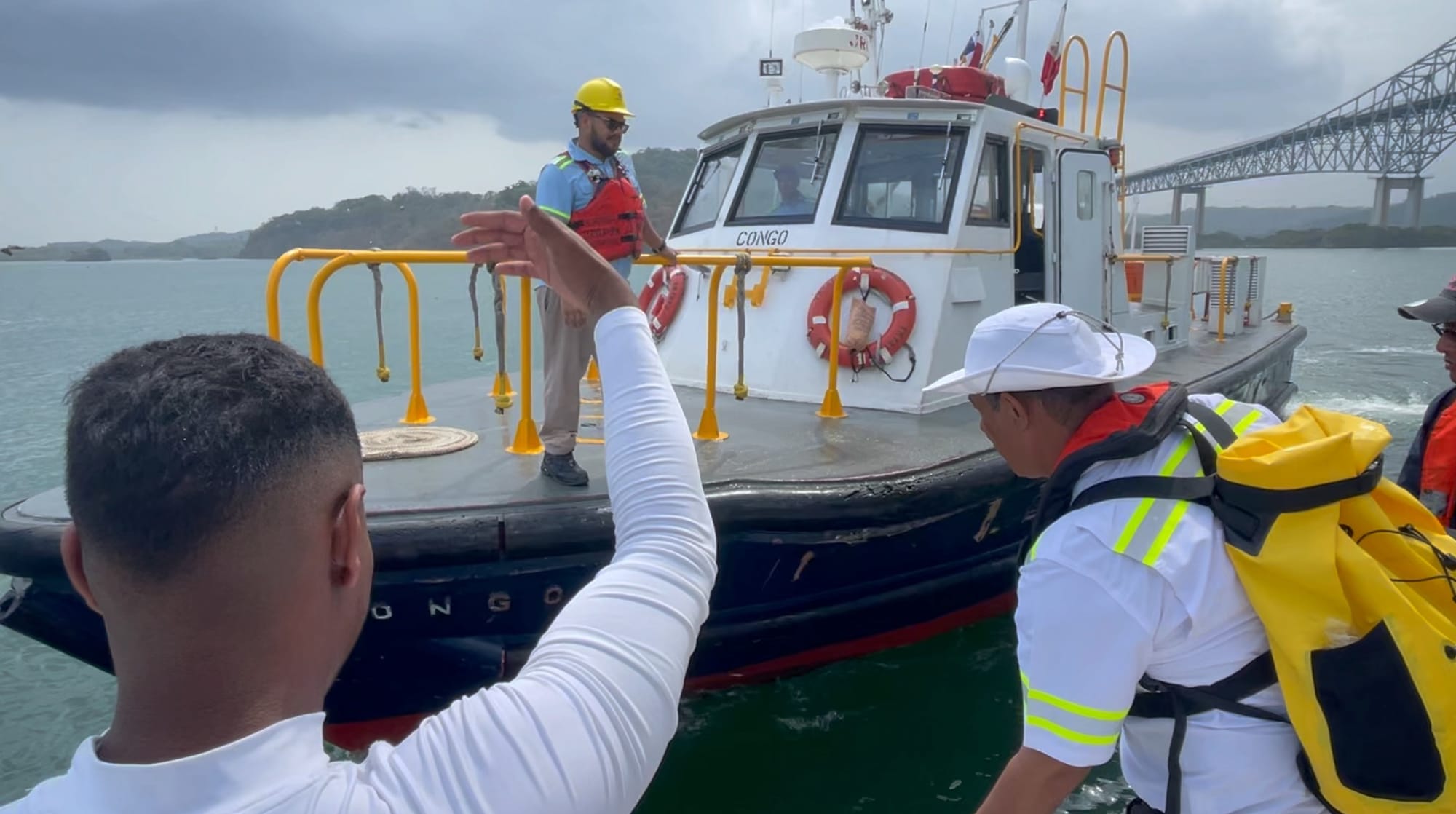
The Pacific feels different than the Atlantic. Is this because we are at the edge of the world’s most vast ocean that we one day plan to cross or maybe because we have accomplished crossing a maritime boundary between 2 worlds? Whatever the reason, the day was very special and unforgettable. The broken Chemex was not a bad omen but more like a celebratory end and beginning.
Member discussion