
Unplanned pit stop in Port Antonio, Jamaica
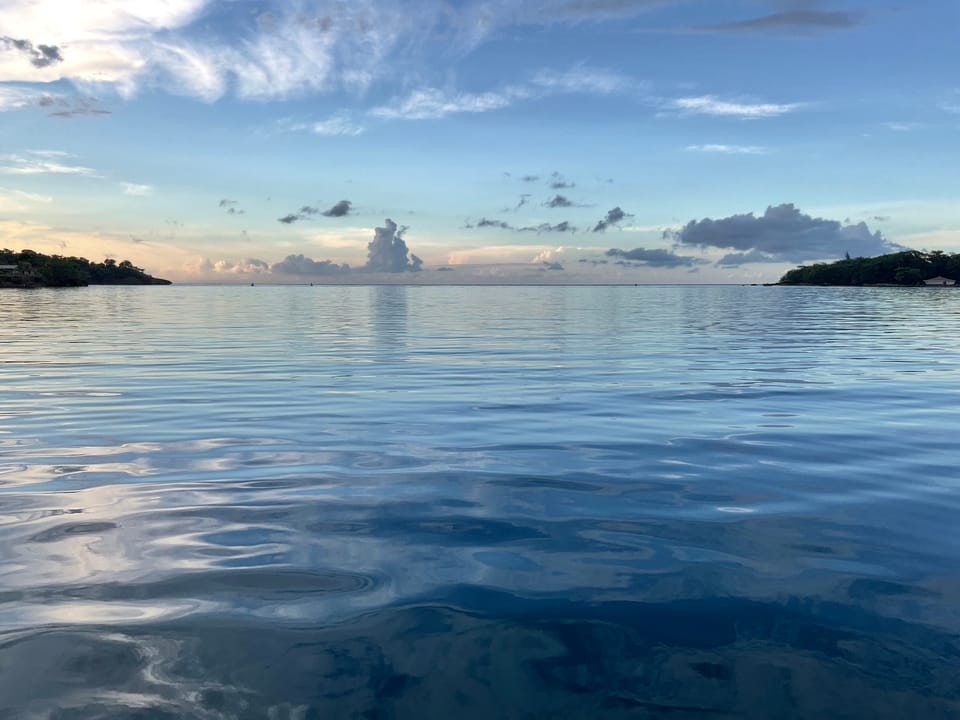
Two nights ago, after nearly 3 solid days of continuous motorsailing east in light headwinds and seas from Cienfuegos, Cuba, we finally passed around the north of Jamaica into the Jamaica channel. Our well earned position enabled us to begin our course change due south to Santa Marta, Colombia. The more southerly orientation meant we could finally shut off the engine and begin sailing in peace and quiet. No more noise, vibration and exhaust fumes for us. Also after these many hours of motoring, I was concerned about our remaining fuel capacity. Due to the high sulfur content of Cuban diesel, we elected not to refill the tanks in Cuba, even though the price was certainly right, less that $1 gallon. While we have some general guidelines as to our motor’s consumption rates and fuel gauges that are to be used as approximations, we have limited prior experience motoring this long and have not yet developed precise measurements for how much we consume.
We were so looking forward to the moment we shut down the iron Jenny and the next 4 days of a smoother, quieter ride beam reaching to South America. It was right around our 6pm watch change when Wendy, who was down below heard a strange and new noise. I came down and forward to where the mast enters into the Pullman cabin. Even with my much less than perfect hearing, I heard the noise as well. Seemed to be vaguely metallic. My first reaction was that it is nothing but a halyard snap shackle rubbing. We went into the cockpit, Wendy, now with her harness on and me having taken it off. We watched the rigid vang tube move a bit and tensioned the vang line to see if that would solve the noise issue. It didn’t and Wendy went forward to investigate. She called to me and said in a no nonsense voice, I needed to see this. I responded that I don't have my vest on and in the same not to be doubted voice, she said, come now. As we weren’t in significant winds or seas and without my harness on, I came forward immediately. My stomach dropped as we watched the mast move forward and aft within the deck opening. After a moment of being dumbstruck, I pulled out my phone to record a video, thinking this is a moment to document. We then went into semi-controlled panic mode. What can we use to stabilize the mast? Will the rig come down? What is the closest port of refuge? How much fuel do we have left? Can we sail there with a very modified sail plan? What tack and heading will have the least amount of stress on the rig? And oh, I am starting to feel seasick now. I better take some medicine. All of these thoughts and more were racing thru my mind.
First we grabbed the tool bag and removed the protective boot covering. Sure enough the mast was no longer wedged into the opening. We quickly located the set of various wooden bungs. We were able to hammer in a few around the mast collar. That seemed to hold at least temporarily but definitely not perfectly. Next, we reefed the full main to its 2nd reef position and furled the solent to 50%. Then we turned the boat to a broad reach. Using our Starlink capability (and very thankfully), we quickly researched the nearest ports to us in Jamaica and within minutes decided on a game plan to sail to Port Antonio, 30 miles away directly downwind. Given the sloppy sea state and maybe 2’ swell, that still means an occasional 4-5’ set of waves that pushes the hull around and stressing the rig. Not wanting to tension the preventer to brace the boom and quiet the sail loading and unloading, we decided it best to drop all sail and simply motor to port. Would that be less stress on the rig? It seems so. Now it is fully dark and we have approximately 6 hours of motoring ahead of us reach port. At first we kept the spreader lights on to watch the rig but after awhile, we turned them off, giving in to the realization that we will hear more trouble before we see it anyway. Gathering as much chart info and other general anchoring options intel, we prepare ourselves for entering an unknown, probably unlit and non buoyed port, with offshore shoals, at approximately 0330. Though completely infused with adrenaline, we tried to return to a modified watch schedule to spell each other and get some rest. We sent our texts to alert Jim, Jamie and Eric of our situation and slowly made our way in the darkness.
I took the first watch feeling stressed, anxious and fearful. Of course the first burst of adrenaline can only last so long especially pared with my mindlessly taking a full dose of Sturgeron (having never done so) and given that one of its side effects for me is sleepiness. Within an hour, Wendy reappeared and said that she couldn’t sleep and I was utterly relieved as I said I am crashing and can’t keep my eyes open any longer. I laid down on the settee, closed my eyes and was out like a light. Forty five minutes later I woke up misread my watch and thinking it was almost time for a watch change, I donned my vest and climbed the companionway into the cockpit and Wendy said its time already? I said yes and looked at my watch and realizing I couldn’t figure out how to tell time and stared blankly and said something inane like, I’m not really sure but I am up, go get some rest….
Thinking I need to get it together and get to safety, the next series of decisions could make things go from bad to worse. Thankfully, the transit to shore was pretty uneventful, save for a few rogue swells that rolled Pinecone from side to side every now and then. As we slowly approached the port, our night vision mostly intact and the fear certainly enhancing whatever vision we still have at 60 years old, we keenly peered into the darkness. Our initial anchorage plan was to locate ourselves outside of the harbor itself. But upon reaching Port Antonio, it became clear that sea conditions and depths were not favorable to do this. So, Plan B - we motored through the lighted buoy entrance into a broad calm harbor with adequate depth and no boats that we could see. We picked a spot, set our trusty Ultra anchor in 20’ of clay/sand and with unspoken relief and high fives we shut Pinecone down and went to bed. Tomorrow, we will begin to sort this debacle (um learning experience) out.
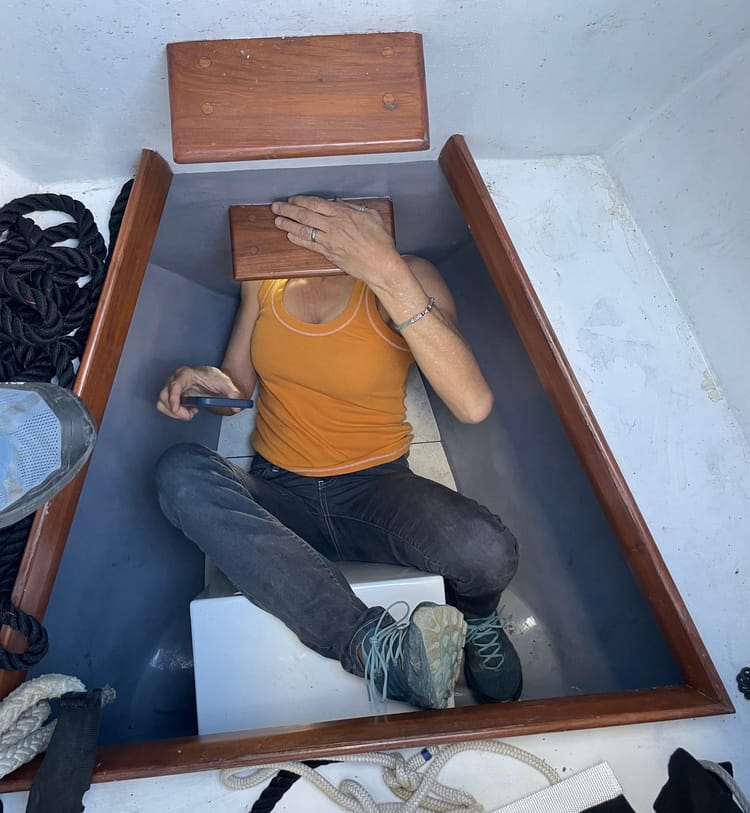
Upon waking the next day, we set about determining the source of the problem. We had great support from Michael, the owner of Outbound, and later the rigger Christian. We futzed to figure out how to remove the fiberglass panels that cover the mast below deck. At one point, we thought we’d have to remove the carefully installed ceiling panels in order to do so which felt overwhelming and depressing. But as Wendy terms me, the master futzer, I kept futzing and removed them, ceiling panels intact. As suspected by OB, the compression wedges that hold the mast in place dislodged. So far, the tie rod bolts that hold the mast to the deck didn’t shear and are still in place. We will inspect them and also reinsert the wedges based on great instruction from Christian. Turns out, hulls 74, 75, and now ours - 76, have all experienced this problem. The tie rod bolts had sheared on hulls 74 and 75 along with the dislodgement of the compression wedges. OB is in conversation with Seldén, the mast manufacturer, about why this happening - they are flummoxed. Next steps are to try and determine the cause so as to prevent it from happening again.
The co-captain’s insight: it’s crucial to learn how to ascertain the difference between when something looks bad and needs to be fixed but is “okay” compared to something that looks bad and is catastrophic. In this case, realizing it was the former gave us both great comfort and caused the ongoing re-wiring of neural pathways….which was counter to the initial perception. So much of the adventure falls into this wonderful category.
Member discussion